 IIM Mumbai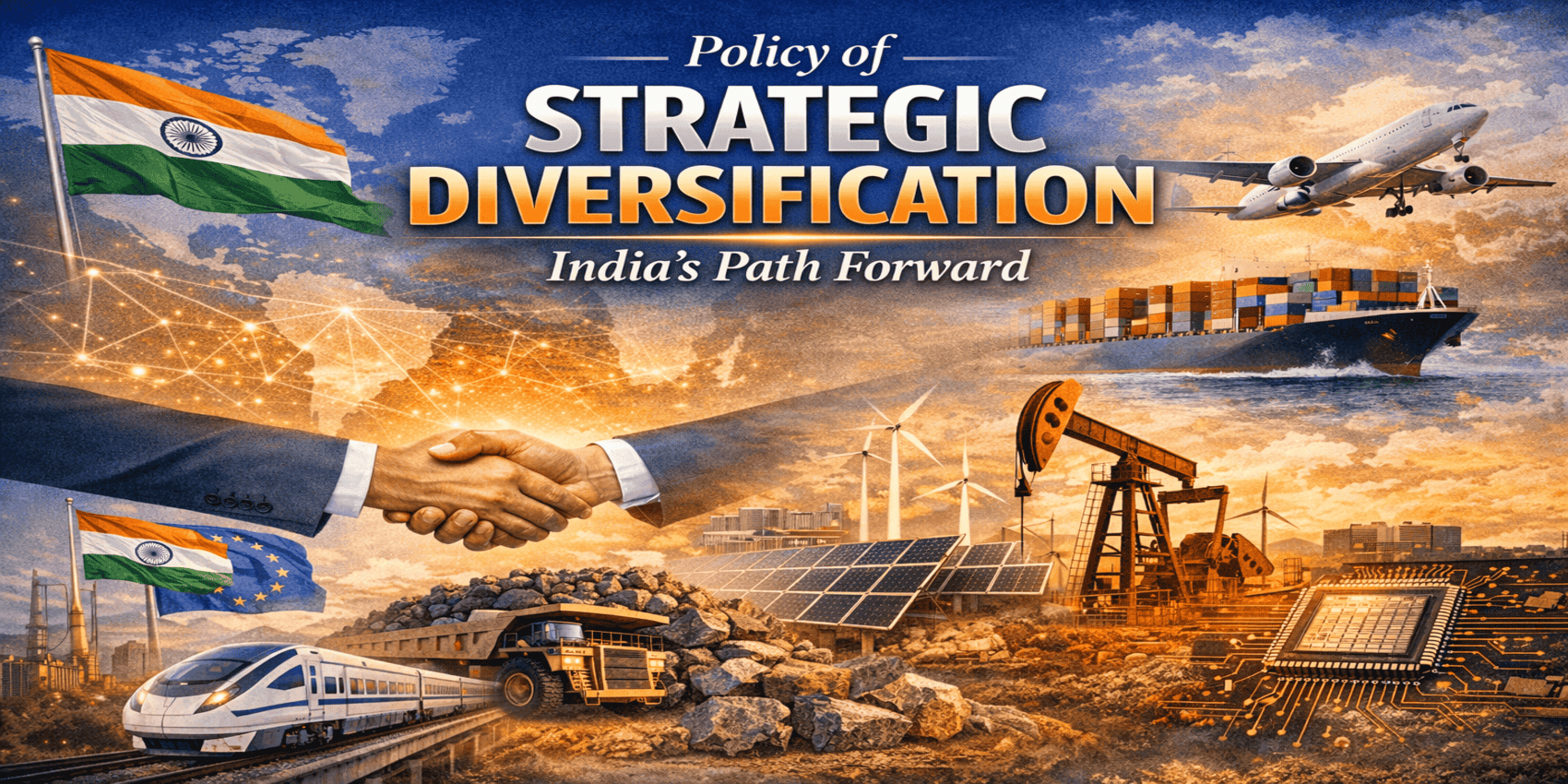
Trades build partnerships, partnerships mould alliances, and in this era of technology, policies shape the future. To first describe Strategic Diversification, we must first understand that it is a flexible policy that countries use as a beacon to navigate this BANI world (an aggregate result of Brittle systems, Anxious people, Nonlinear outcomes, and Incomprehensible complexity). Key features of this policy include diversifying trade routes, developing new energy sources, mining critical minerals, and even redefining the existing supply chain. Defining this broad policy leads us to ask the obvious question: whether adopting strategic diversification guarantees cementing India's position in this dynamic world order?
And the answer is not so straightforward.
Earlier this year, India negotiated one of the most strategic economic partnerships with the EU, christened as "Mother of All Deals". That deal combined the world’s 4th and 2nd largest economies, totalling a GDP of over USD 24 trillion. History was made that day, as it enabled over 90% of India’s exports to have immediate duty elimination. This landmark FTA laid the groundwork for umpteen opportunities across sectors ranging from textiles and pharmaceuticals to chemicals and engineering equipment. It aimed to leverage a combined 25% of the world's population, and this agreement proposed creating global demand for local manufacturers in India.
Through this historic India-EU deal, we get a sense that today's India is writing its own growth story. As per the Commerce Ministry's report, Indian exports expanded to over USD 634 billion for the April-December 2025 period. And in January 2026, the World Bank Group pegged India's growth at 7.2% for fiscal year 2025-26, with the service sector driving the story. These facts bolster India’s goal to amalgamate its young workforce with global opportunities.
But what threatens this story is the heightened global uncertainty. For the Viksit Bharat 2047 vision to enjoy tailwinds, India must aim to fortify its growth trajectory by creating a unique array of trade deals worldwide through strategic diversification, safeguarding its national interests by meeting domestic requirements, and nurturing its industrial ecosystem to meet global demands. While India scales ahead with its newfound policy, the undercurrent is that policies that once dictated governance on an international scale are now changing at lightning speed. Each country aims to reap maximum benefit by strengthening its stronghold resource.
Last year, in 2025, the USA imposed a 25% reciprocal tariff on all Indian goods to limit the widening trade gap, which was increased to 50% to penalise India's import of Russian Urals. In February 2026, the USA announced it would reduce the earlier-imposed tariffs to 18% and, as a reciprocal trade effort, wants India to consider importing Venezuelan oil. This significant rollback of tariffs was aimed at giving Indian industries a competitive advantage over those in ASEAN countries, which face tariffs of 19% or higher. Union Commerce and Industry Minister Piyush Goyal stated regarding the ongoing trade negotiations that “Today, India negotiates from a position of strength. We are a $4 trillion economy today, but it is going to be $30-35 trillion by 2047 when we are a developed economy.”
Thus, in a world where developments around policies are changing rapidly, it is prudent for India to trade with an arm's-length transaction doctrine and continue this path of strategic diversification with all its global partners. This policy is not risk-free; adopting strategic diversification adds a layer of scepticism as it slowly erodes the stability which the global partners once yearned for. But when one takes a step back to look at the bigger picture, we observe that evolution requires continuous improvement, and this policy might be our best path forward.
Ultimately, the policy of strategic diversification is not limited to international trade. Today, it is being used to assess India's current position at a crossroads amid sweeping reforms in the energy and technology sectors. Last year itself, the Ministry of Coal reported that India has the 5th largest coal reserves globally and is the 2nd largest consumer, with 70% of its energy mix powered by coal. In COP26, India presented its five nectar elements (Panchamrit) of India’s Climate Change, one of which is to achieve net-zero by 2070. Therefore, India's energy imperative lies in developing policies that promote the adoption of renewable power and help India achieve energy independence through diversification.
To support this narrative, in the 2026 budget too, the government focused on achieving critical mineral sovereignty by establishing a dedicated rare-earth corridor across Odisha, Andhra Pradesh, Tamil Nadu, and Kerala. External trade-partners like the US invited India to join the Pax Silica Initiative (a US-led strategic initiative to secure the supply chain of critical minerals) to build logistics capabilities, advance manufacturing, and develop new frontier technologies such as AI and semiconductors. To push forward India's Green initiative efforts, an allocation of INR 20,000 Cr in the 2026 Union Budget was made for the development and deployment of Carbon Capture, Utilisation and Storage technologies (CCUS) over the next five years.
In a nutshell, strategic diversification policy-making in the context of managing internal resources is about putting India first by analysing its current energy portfolio and assessing the challenges of adopting newer technologies.
Till now, we have gained an overall view of policy formulation; what remains is the implementation of strategic diversification. Implementation of any policy is heavily dependent on a resilient internal system that can adapt to rapid changes. If we take a closer look at the unit economics of the Indian modal mix (as illustrated in the KPMG article - Logistics costs to GDP: Can Budget 2026 finally move the needle?), trucks carry 60–65%, rail carries 27–28%, and waterways under 2% of the total freight, and on an average, cost of hauling 1 tonne of cargo is ₹2.5–₹3.0 for road, versus ₹1.5–₹1.8 for rail and ₹1.0–₹1.2 for waterways, resulting in uneconomic utilisation of transportation modes. To mitigate this underlying problem, the 2026 union budget specially allocated INR 12.2 lakh crore in CapEx to boost the Indian logistics network. It focused on developing 20 new National Waterways, 7 high-speed rail corridors (growth connectors) and Dedicated Freight Corridors (DFCs) to unlock rapid industrial growth while lowering logistics costs and carbon intensity.
In conclusion, we can infer from the recent policy changes that the requirement for this policy stems from India's ability to drive the new world order. Creating opportunities through effective policy-making and efficiently utilising them is the crux of strategic diversification. And in an era defined by rapid information flows, this policy is the key to synthesising complex global relations and creating a path forward.