 IIM Mumbai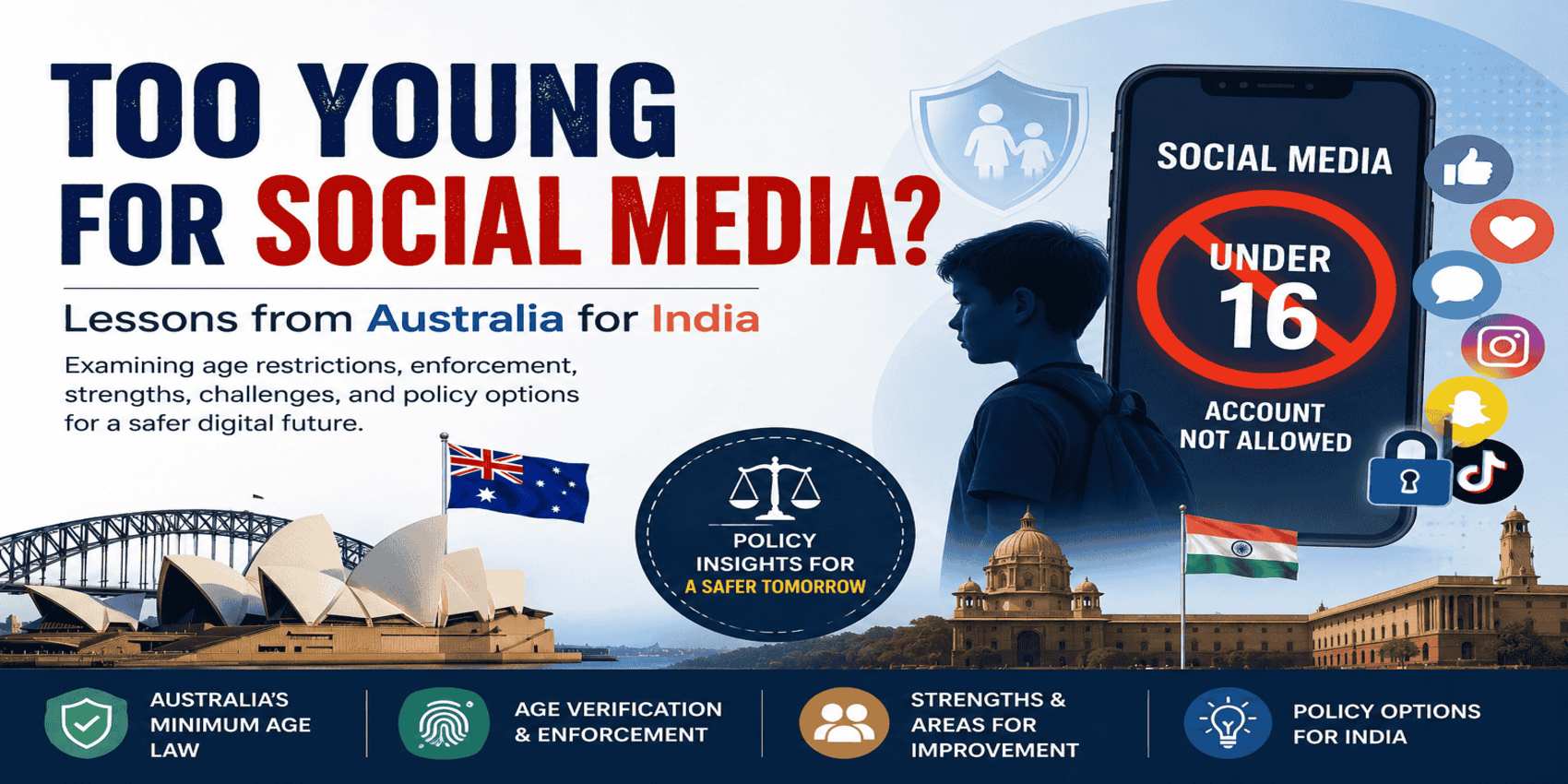
While presenting the state budget for the financial year 2026–27, the then Chief Minister of Karnataka announced that children under 16 would be banned from using social media. The proposal aims to address concerns about increased mobile phone use among children, including its potential impact on academic performance and physical fitness. Detailed policy measures, including the implementation framework, are yet to be announced.
This proposal may therefore operate alongside section 9 of the Digital Personal Data Protection (DPDP) Act, 2023 and rule 10 of DPDP Rules, 2025, both of which list provisions to obtain verifiable consent of a parent or legal guardian before processing a child’s personal data. This initiative of the Karnataka Government aligns with the central government’s plans for a similar policy, as mentioned by India’s Union IT Minister during the India AI Impact Summit 2026. The governments of Andhra Pradesh and Goa, as well as those of Germany, France, and Malaysia, are also working on similar bills.
As Karnataka becomes the first Indian state to impose such a ban, there will be significant implications for all stakeholders, including children themselves, parents/guardians, schools, social media companies, and law enforcement agencies. It is wise to analyse similar legislation in other countries to understand the enforcement mechanism and effectiveness. This article reviews the recently implemented Social Media Minimum Age Act of Australia and extends it to the Indian context.
Case Study: Online Safety Amendment (Social Media Minimum Age) Act 2024 - Australia
Australia introduced a minimum age of 16 for accounts on certain social media platforms, requiring platforms to take reasonable steps to prevent under-16s from opening accounts.
Enforcement Mechanism
As per the Age Assurance Technology Trial Report, age verification could happen through:
- Facial age estimation
- Digital ID verification
- Verification by parents
It can be implemented through specialized third-party service providers. While different systems may be suited to different platforms, the report notes the need for standardised systems that work across multiple platforms and services. Moreover, a combination of methods may be used to reduce circumvention.
Courts can order penalties of up to 49.5 million AUD if firms do not take reasonable steps to prevent underage users, thereby strengthening enforcement through negative reinforcement.
In India, age verification could possibly be implemented using Aadhaar-based authentication systems.
Strengths
- The policy helps eliminate social validation mechanisms such as the number of likes, followers, etc., that create unnecessary stress. In other words, the ‘network effect’ is disrupted due to the absence of individual accounts, thereby reducing peer pressure and promoting psychological safety.
- It prevents active participation, including posting, liking, and commenting, which are major drivers of addictive behaviour.
Areas for Improvement
- Since the restriction primarily focuses on account creation, minors can still view social media content in a logged-out state.
- The rules do not directly regulate algorithmic recommendation systems that drive engagement and cause addiction. While restricting account creation may weaken algorithmic feedback loops, behavioural profiling, and reduce personalization, recommendations can still be provided based on device usage patterns, cookies, browser session IDs, and trending content. As a result, some drivers of excessive engagement may remain.
- Platforms may reposition their services as gaming, messaging, or educational platforms to avoid being classified as social media platforms. For example, Rapido temporarily reframed its ‘bike taxi’ service as ‘bike parcel’ service when the Karnataka High Court upheld the ban on bike taxi services imposed by the Karnataka Government in June 2025.
- Children may access shared family accounts or their parents’ accounts. This poses an even bigger risk in India, where smartphones are shared between children and parents in many households.
While the Australian policy offers opportunities for further refinement, it has been designed as a risk-mitigation or social media harm-mitigation measure, and not as a complete solution. The explanatory statement provided by the Australian Government itself notes that the framework ‘is not the be-all or end-all solution’ and is meant to complement other online safety regulations.
Policy Considerations for Governments in India
In response to the Karnataka Government's ban, Meta warned that such regulations might push children towards unsafe, unregulated websites. This, coupled with the improvement areas already highlighted in the Australian context, calls for more innovative and balanced policy measures as an alternative to blanket bans. Some of the measures that governments in India could consider are as follows:
- Incentivize social media firms to introduce a child-safe version of their existing apps, such as ‘YouTube Kids’.
- Design and enforce child-specific design standards such as the UK’s Age Appropriate Design Code. The code could include provisions such as strict content moderation, stronger parental controls, the removal of recommendation algorithms, and restrictions on active engagement features such as comments and likes. These measures would align with the recommendations of Brookings, a well-known public policy think tank.
- Regulators can provide ‘Child Safe Platform Certification’, which would not only be used for approvals, but could also enhance the reputation of social media apps and firms.
- As suggested by Meta, laws that empower parents to approve teen app downloads on the app store can be explored.
In addition to legal regulations, governments should also invest in creating awareness and improving digital literacy to help children understand the negative effects of social media. Such approaches aim to augment policies borrowed from other countries while preserving their unique strengths.
Conclusion
Time will only tell whether such policies help achieve their desired objectives. Until then, it is necessary to continuously track outcomes, and, yet again, the Australian government has developed a research-based evaluation framework for this.