 IIM Mumbai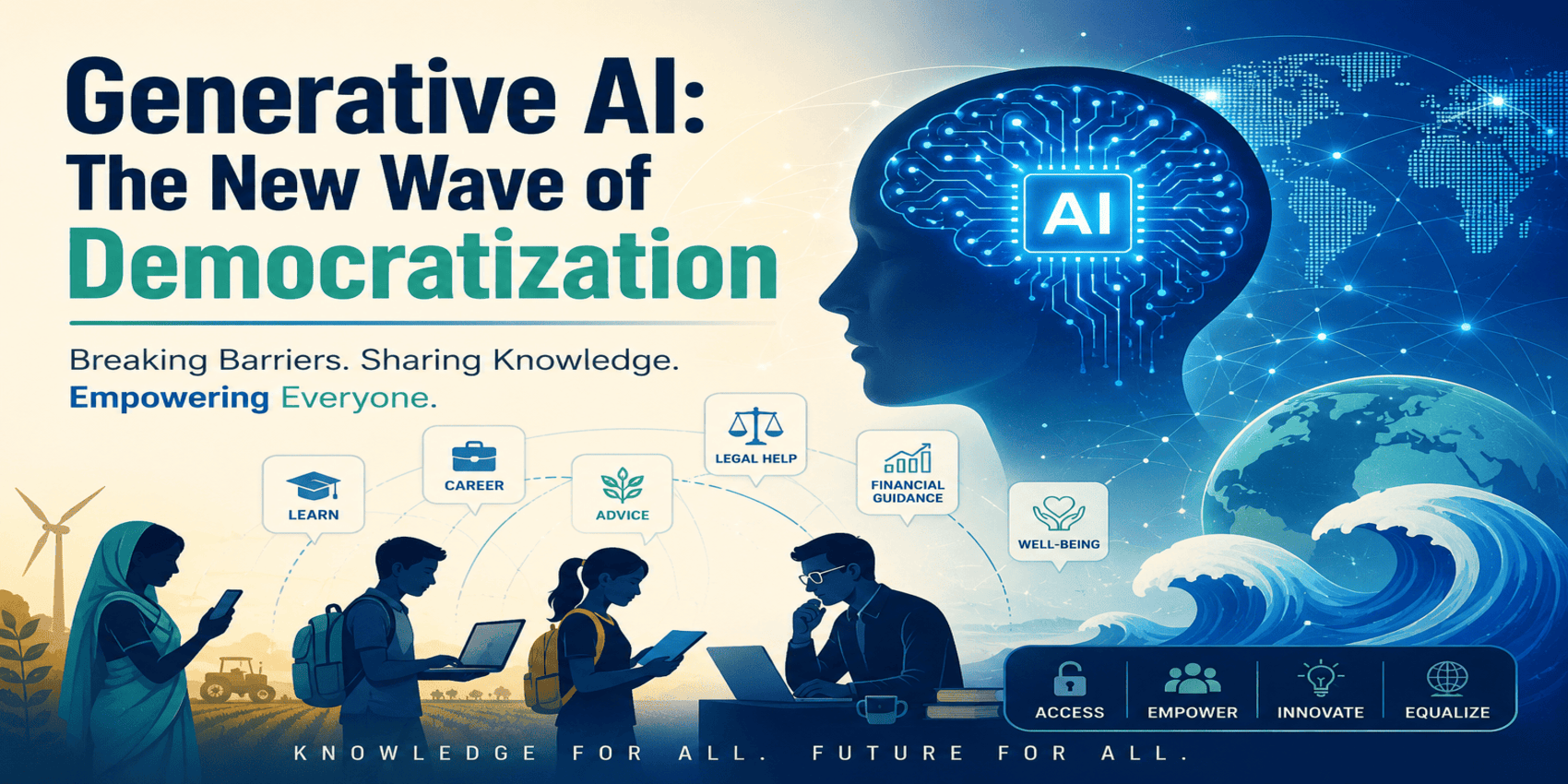
Which career suits me best? Which skills should I work on? Earlier these questions were directed towards our seniors in college, maybe our father’s friend or that neighbour who was in good corporate position. However, today this information is just one click or rather one prompt away. Welcome to the Artificial Intelligence (AI) world that has decentralized the information that was once only accessible to people with proximity to certain socio-economic groups.
This article explores how generative AI is changing access to knowledge, why so many people rely on it, the challenges that arise with this growing dependence, and the policy measures needed to ensure its benefits are shared responsibly.
How AI Replaced the Gatekeepers
Before this new wave, the internet was already at the forefront of democratizing information. We all became accustomed to search engines, YouTube, learning platforms and others. What generative AI platforms like ChatGPT, Gemini, Claude etc. brings unique is the power of contextualization. It can analyze the context and give tailor made responses which are quick and concise.
In economics, it is taught that information asymmetry creates market inefficiencies. It distorts market as was shown by Nobel Laureate George Akerlof's 1970 paper on the "Market for Lemons". The same logic extends to social mobility. A career counsellor, a chartered accountant or a legal advisor for most people remained out of reach, not for lack of need, but for lack of money, access, and the right circles.
If one sees the whole success of premier institutes like IIT/ IIM, it stems from the fact that they knew how to land that internship, how to build career in finance, how to crack that top company interview round. Of course, quality of education mattered. Although, the holy prep material and informal guidance helped them get a headstart.
Then came the era of online lectures and classes which made coaching accessible to masses. Now we have the AI tutors. Solving doubts, explaining each step multiple times, creating personalized plan and interactive quizzes. And it is not just limited to education. Doing assignments, brainstorming problems, drafting messages and many more, AI has become our daily assistant. Farmers seeking advice, people starting businesses, creating diet and exercise plans, budgeting and many more, AI has become our teacher, financial advisor, therapist and what not.
AI has made things unimaginable possible. Three 22 year old founders (Brendan Foody, Adarsh Hiremath, and Surya Midha) dropped out of college to build Mercor, a revolutionary AI-driven recruitment platform. They raised millions, achieving a $10 billion valuation and becoming the world’s youngest self-made billionaires. The shift is there to stay.
The Trust Deficit and AI as an Equalizer
India is at the forefront of this shift. A 2024 Deloitte survey across 13 Asia Pacific economies found that 93% of Indian students and 83% of Indian employees actively use generative AI, ranking India first in the region.
One may wonder why it was adopted at such an unprecedented rate. The reason being trust. We are taught that humans are social animals. However still in society, trust is the biggest issue. Information asymmetry meant people cannot trust other people. And resources were always a constraint. For the majority, a second opinion of say career counsellor, lawyer, chartered accountant or a mechanic comes at a cost and time. This erosion of trust in traditional methods is precisely where AI has stepped in. AI has now empowered the people to understand complex things in simple language. Information gap thus has been reduced.
Apart from information gap, skills gap too is getting decreased. Years of work experience have started losing relevance. It is more about adapting skills. Now AI can even do complex data analysis, coding and modelling. AI has become a kind of equalizer. Everyone must adopt it or face the fear of being left behind, thus forcing workforce-wide reskilling with AI at the center regardless of their work experience in industry.
Challenges Remain
As the saying goes, technology is neutral, it's how you use it that matters. And the same ecosystem enabling this democratisation carries serious risks to society. Researchers are now worried about people using AI to build toxic chemicals, bombs, hack computer systems or even for crimes like theft, murder and smuggling.
The veracity of AI generated content is always an issue, exacerbated by the opaque algorithms that run behind them. AI systems still get things wrong, sometimes confidently so. In high stakes domains like healthcare, taxation, or legal advice, a plausible sounding but incorrect answer can cause irreversible harm. Fake AI generated data has become another headache for countries worldwide leading to disinformation. Blindly following AI is not advisable, and yet that is what many users tend to do.
Poor internet connectivity and digital literacy still make it difficult for rural areas to catch up. Then there are language barriers too. A Microsoft report states that AI adoption in the Global North is growing nearly twice as fast as in the Global South. The risk is not just that AI bridges the gap, it may worsen it.
Too much reliance on anything is not good. Scientists have warned of declining cognitive skills. Students are not learning instead using AI impacting their brain growth negatively. And privacy concerns, ethical issues, hallucination are still challenges that we are yet to overcome. Big tech players are constantly trying to fix the loose ends, but they have long to catch up.
Policy Implications and the Path Forward
For this democratization to be effective and sustainable, some policy shifts are needed.
AI Infrastructure is an important pillar. Data centres, GPUs, reliable internet connectivity and others are must to access AI. The India AI Mission, approved in 2024 with the budget of around ₹10,000 crore over five years, is a step in the right direction.
Alongside infrastructure, AI literacy needs to be woven into school curricula and vocational training the way financial literacy programs are pushed. A citizen who understands how AI works, including its limitations, uses it prudently.
Finally, regulatory guardrails, especially for AI in healthcare, legal, and financial advisory, must be there to assign clear accountability for AI generated information, without slowing down the innovation.
Democratization of information has always been one of the promising benefits of internet economy. Power has been quietly flowing from the top downward and AI is the latest, and perhaps the most significant chapter in that story. AI, if deployed thoughtfully with inclusivity and equity can serve all of us. We must remember that technology should never become the master of the human beings it was built to serve. The technology offers the promise. Policy and intent determine whether this democratization will sustain in a healthy manner.