 IIM Mumbai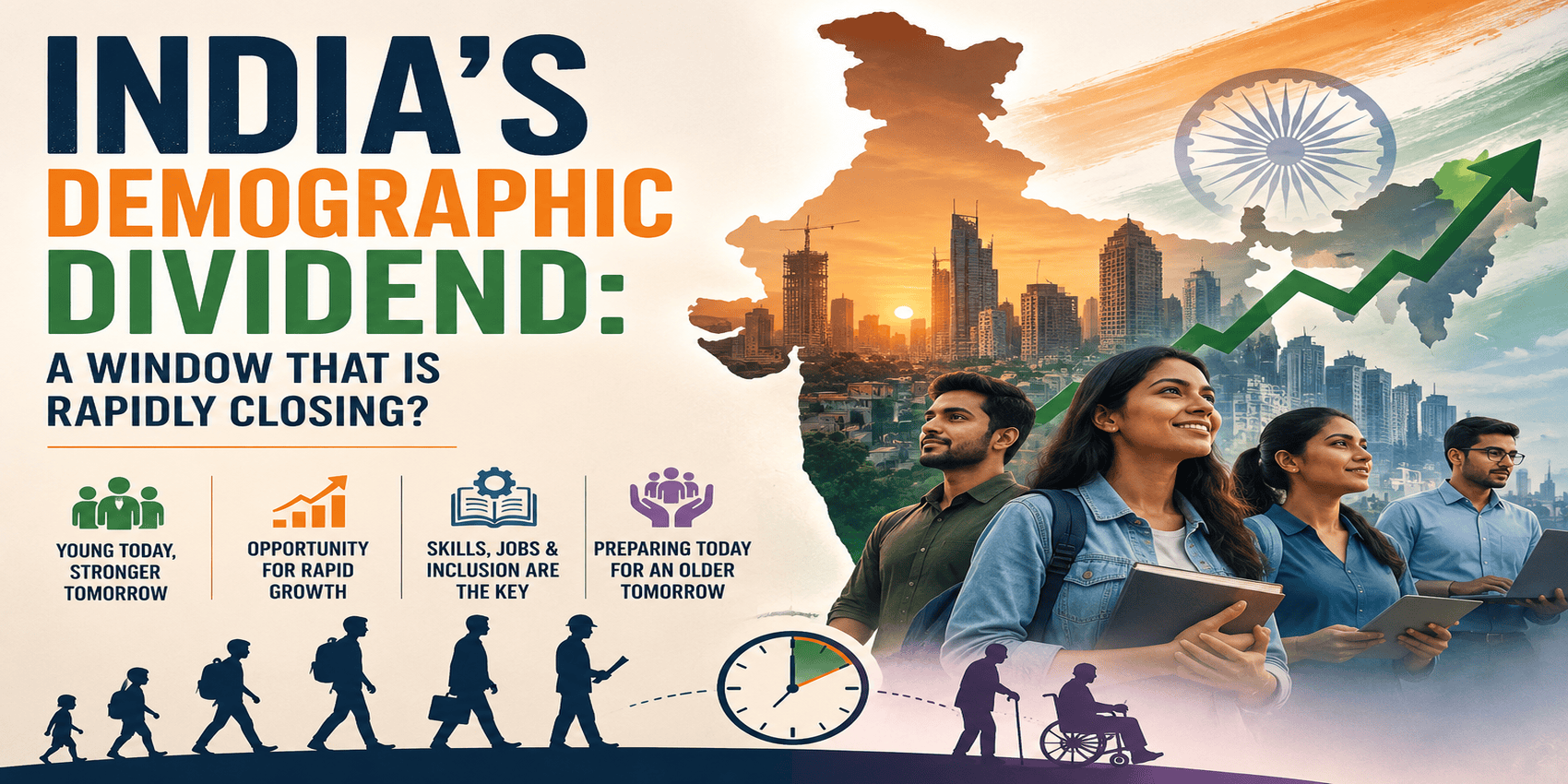
India's Moment of Opportunity
India is today undeniably one of the most attractive countries in terms of demographics. To begin with, this is because about 68% of Indians are of working age (15–64 years). In addition, the median age in India is only 29 compared to 39 years in the United States, 45 years in Germany, and 49 years in Japan. UNFPA notes that India's demographic window opened in 2018 and will remain open until 2055. This is a fantastic opportunity for India to accelerate its economic growth. Even so, even a young population is not a guarantee for prosperity if there are not enough jobs, proper education, and access to skills development. India has a unique opportunity to benefit from its demographic dividend, but it must address a series of challenges and dilemmas.
Global Examples of a Successful Demographic Dividend
History shows that a favourable fertility structure can translate into rapid economic growth when it is combined with the right conditions. The United States experienced a strong baby boom between 1946 and 1964. People born during this baby boom entered the workforce gradually from the early 1960s. Their economic output is estimated to increase GDP by 0.4 percentage points annually.
Japan had a much shorter baby boom, only lasting between 1947 and 1949. However, that was enough to propel Japan's GDP growth into double digits over the ensuing two decades, starting in the sixties. At one time, Japan was projected to overtake the USA as the world's largest economy.
China had a different type of dividend boom due to the enactment of the one-child policy in 1979. This led to a high worker-to-dependent ratio due to a large working-age population, because of sky-high fertility rates in previous decades, and fewer dependents as a result of fewer children being born after the one-child policy.
These experiences illustrate the importance of India utilising its demographic dividend if it wants to change its economic destiny.
India's Progress and Policy Response So Far
A younger workforce is already driving India's economic momentum. It has strengthened growth across manufacturing, construction, IT-BPM services, e-commerce and fintech, helping the country remain among the world's fastest-growing major economies.
To translate this demographic advantage into long-term development, the government has placed it at the centre of its Viksit Bharat 2047 vision. Several flagship programmes have been introduced to support that objective. The Skill India Mission and Pradhan Mantri Kaushal Vikas Yojana (PMKVY) provide vocational training to millions of young people. The National Apprenticeship Promotion Scheme supports industry partnerships, and the PM-SETU initiative is modernising a thousand Industrial Training Institutes across the country. The National Education Policy (NEP) 2020 supports this effort by mainstreaming skill-based education. The government has also introduced Mission Shakti and dedicated National Skill Training Institutes for Women, recognising that the dividend cannot be realised without wider participation from women.
Key Challenges Facing India's Demographic Dividend
India faces a major concern because fertility has fallen below replacement levels before the country has achieved the income levels seen in advanced G20 economies.
According to NFHS-5 and SRS data, India's total fertility rate is between 1.9 and 2.0, already below the replacement level of 2.1. The decline in fertility is a natural part of economic development. Yet, a problem arises when fertility falls below the replacement level before average income reaches a sufficient level. In most of the developed world, per capita GDP rose to $30,000 before fertility began to decline below the replacement level, whereas India's GDP per capita is only around $ 3,000. There is a real risk that India will grow old before it becomes rich.
There is also an issue of female participation in the total workforce of India. On paper, female labour participation rose from 23 per cent in 2017 to 41 per cent in 2023. But this is still low compared to other developing countries on a similar economic path to India, such as China and Vietnam, where the number hovers around 60 per cent. Also, most women in the workforce are self-employed or have low-paying jobs compared to their male counterparts. This leads to underutilisation of female potential in the Indian economy, and leads to a lower contribution to the economy. The McKinsey Global Report has pointed out that India is missing 700 billion dollars in GDP every year due to female under participation in the economy.
India also needs to create high-productivity jobs at a much higher rate. Many highly educated students or workers are forced to immigrate to Western countries so they can get the economic reward that matches their technical skills. This leads to brain drain and loss of the most productive people from the workforce. Also, around 46 per cent of Indians are employed in the primary sector, which accounts for only 16 per cent of GDP, according to NITI Aayog. We need to make sure that more workforce participants participate in the Manufacturing and Service sectors, as they have higher productivity and economic impact as compared to the primary sector.
Looking Ahead: Preparing for an Older India
India's demographic dividend would not last for a very long time. Today, people over the age of 60 account for 11 per cent of the population of India, according to UNFPA. However, this number is projected to increase to 20 per cent by 2050. This would lead to increasing demand for healthcare and long-term care infrastructure. If this is not addressed well before the 2050s, it could strain public finances in the same way it already strains developed countries with a similar ratio.
France shows how quickly this can turn into a crisis, even for a wealthy country. Its pay-as-you-go pension system has seen the number of contributors per pensioner fall from about four in the 1960s to fewer than two today. The 2023 attempt to raise the retirement age from 62 to 64 triggered months of strikes, and the pension system is still projected to remain in deficit for years. If France, with decades of institutional capacity and a much higher per capita income, continues to struggle with the fiscal consequences of an ageing population, India's task at a much lower income level is likely to be harder still.
Conclusion
India's demographic dividend is real, but it is not guaranteed. Its long-term outcome will depend on decisions taken today. Expanding skills, creating productive employment, encouraging greater participation of women in quality jobs, and strengthening healthcare and pension systems are all essential before population ageing gathers pace. The window is open only until around 2055. Genuine action, not simply being young, will decide what India makes of it.